Why AI Can’t Replace a Skilled
Color Analyst
Let me explain why Ai can't replace a skilled color analyst using my own personal experience (not just theory).
Over the years, several app developers have reached out to me about their color apps. One of them had a great idea: point your phone at a sweater or a lipstick, and the app would tell you whether that color worked for your season (as long as you already knew your season).
This was before AI was part of everyday life, and I thought it was fantastic. I was genuinely excited about it.
Then the developers took it a step further. They wanted apps that would look at your coloring and tell you what season you are. One used the four-season system; the other used twelve.
I was a lot less excited about that, and I told them so. They kept pushing anyway.
I still really liked the original color-matching app, so when one developer offered to share revenue from in-app purchases if I contributed some color suggestions and introduced the app to my subscribers, I agreed. For a few months, it brought in a nice little side income.
Then he started pushing hard for me to promote the season-analysis app, too. I said no. I couldn’t, in good conscience, recommend something to my clients that I didn’t believe in. (It’s the same reason you won’t see me promoting many products on my site unless I use them myself.) I made it clear I still liked the original app.
I never heard from him again, and the side income stopped.
I share that story because I’ve been skeptical of “instant” color analysis for a long time, well before ChatGPT came along.
Lately, a lot of people have told me they’ve “already had their colors done” by uploading a selfie to ChatGPT. I understand the appeal. It’s fast, it’s free, and the answer sounds very sure of itself. If you’re just curious, it can be a fun place to start.
But after more than 30 years and over 8,000 client analyses, I want to explain, honestly and without the drama, why a chatbot’s answer and a skilled color analyst's analysis are two very different things.
I’m Not Anti-AI
This isn’t about being afraid of technology. I use it every day. In fact, I embraced AI early on, especially for my artwork.
Not everyone has been happy about that. I’ve received some negative comments about my use of AI in my art, and a few of them were, in my opinion, pretty extreme. But one woman left a comment that stuck with me. She said my work was an example of the “humane use” of AI.
I’d never heard that term before, so I looked it up. It generally means designing and using AI in ways that put human well-being, dignity, and ethical values ahead of pure speed or profit. That sat well with me.
I use AI to illustrate ideas about color analysis, makeup, face shapes, and more. It does a far better job than the hand-drawn illustrations I used when I first built my website.
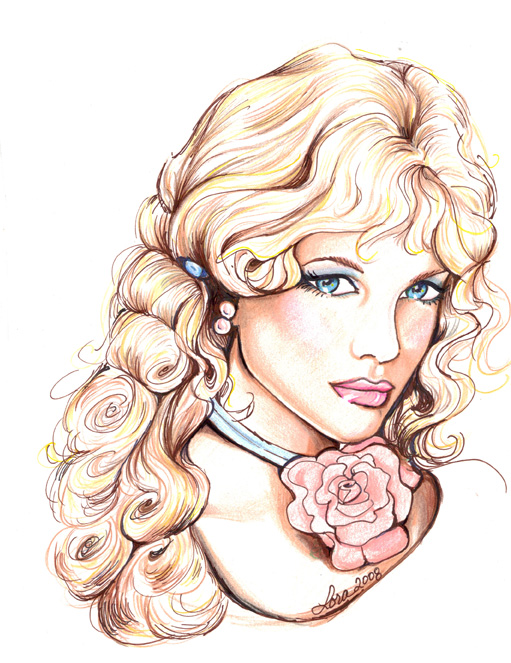
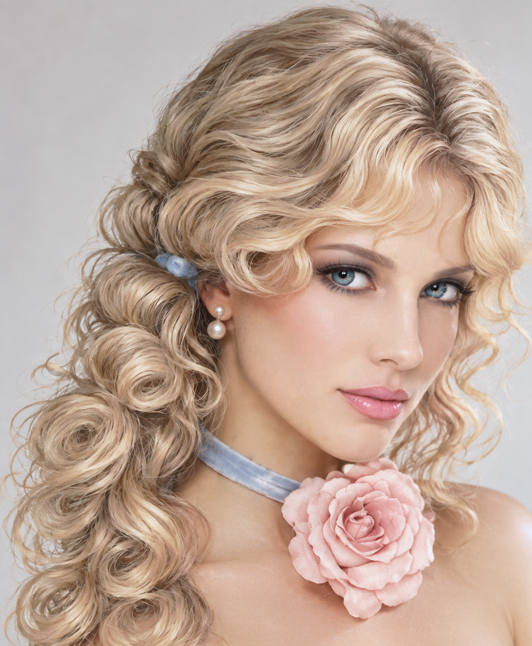
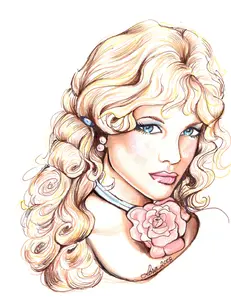
Above Left: the very first image I put on my website in 2008 was my own artwork. Right: an AI version of this lady, who's a Light Summer, by the way.
There’s no comparison.
Like any powerful tool, AI can be used for good or bad. I’m well aware of the downsides, and like millions of other people, I’m especially troubled by its environmental impact. It needs to be fixed, and AI needs to be regulated. But I also see how it’s helping solve some very big problems, as well.
As I stated, it's a powerful tool. We can use it humanely or inhumanely.
When it comes to color analyzing a real person, though, it misses the mark too often, and for several reasons.
Your Photo Isn’t Your Face
When you upload a photo, the AI isn’t looking at you. It’s looking at what your camera decided you looked like. Phone cameras automatically adjust white balance, brighten shadows, smooth skin, and sometimes warm up or cool down the whole image to make it “look nice.” Then there’s the lighting in your room, the color of your walls bouncing onto your skin, whatever you’re wearing near your face, and any filter or beauty setting quietly running in the background.
Take three selfies in three different rooms, and you can easily get three different answers. I’ve watched it happen.
This is also why I don’t recommend that new analysts specialize in virtual color analysis until they’ve built up plenty of in-person experience. Lighting is everything, and only experience teaches you which photo truly reflects a person’s coloring and which one is being skewed by the light, a tan, or other factors.
Garbage In, Garbage Out
There’s an old saying in the computer world: “garbage in, garbage out.” It applies to AI more than ever. An AI system can only be as good as the information it learns from.
At the risk of sounding like a Debbie Downer, there’s simply too much incorrect and conflicting information about color analysis online, and that’s exactly where AI gets much of its training.
If blogs and videos say that anyone can be any season, that it’s all about skin tone and nothing else, or repeat any number of other common myths (I cover many of them in my free report about Color Analysis Myths). This is what AI learns, too.
Confidence Isn’t the Same as Accuracy
One thing AI is very good at is sounding right. It’ll tell you you’re a Soft Autumn with total certainty, give you a lovely paragraph about why, and hand you a palette to go with it.
But ask it again tomorrow with a slightly different photo, and you might be a True Summer. There’s no accountability behind the answer, and no way for it to check itself against what’s actually happening on your face.
I’ve spent f my career focused on consistency and accuracy, because that’s where color analysis earns its trust. If two skilled analysts look at the same person under the same conditions, they should land in the same place, or very close to it. A tool that changes its mind based on lighting and camera settings can’t offer that.
Why 4 and 12 Seasons Just Aren’t Enough
I've been touting this for years: most people don’t fit perfectly into 4 or 12 seasons.
The 12-season system was a big step forward from the original four seasons, and it helped a lot of people. But over time, I kept meeting clients who didn’t fit neatly into any of the twelve boxes. They sat between seasons, or they had qualities pulling in two different directions at once. Forcing them into the closest category meant giving them a palette that was “close enough,” and close enough often means half the colors work and half don’t.
That’s why I developed the ColorBreeze® 28-season system. More seasons isn’t about making things complicated. It’s about giving each person a palette that actually matches their coloring, instead of rounding them off to the nearest option.
Most AI tools rely on the 12-season model (or even the original four), because that’s what’s most common online. So even in a perfect world with a perfect photo, (or let's be honest, even with in-person analysis), you’re still being sorted into a system that doesn’t have room for too many people.
My Own Experiment with ChatGPT
To put this to the test, I created an AI image of a man whose coloring closely resembles my boyfriend’s. He didn’t want his real photos used (he hates being photographed almost as much as I do), so this was the next best thing.
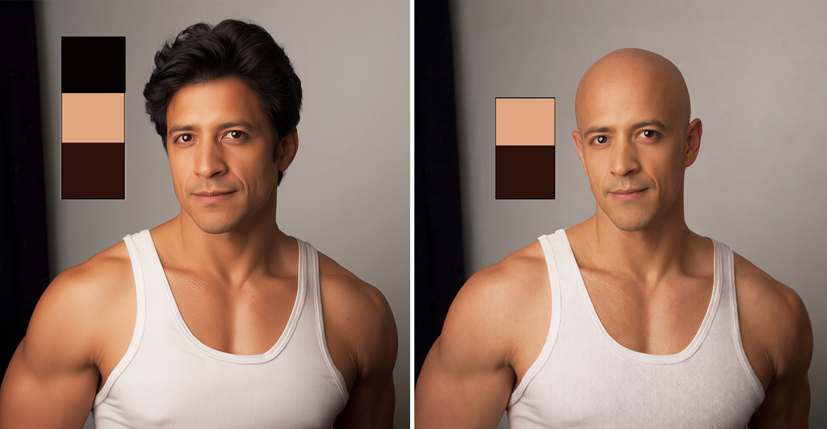
Ai image I created to resemble my boyfriend's coloring.
(The muscles aren't for his vanity; he used to lift weights constantly ;)
Twenty-five years ago, his hair was jet black. His skin had warm overtones, made even warmer by years in the sun, and his eyes were dark brown. I draped him, and I’ve seen him in countless colors over the years. He was, without a doubt, a Deep Winter.
Today, he shaves his head completely. Losing that black hair lowered his overall contrast. But does that make him a Soft Autumn, like both of those season apps insisted about 12 years ago? No. I’ve seen him in warm beige, and it doesn’t do him any favors.
So I uploaded the shaved-head image to ChatGPT. I’ll give it credit: it recognized that he still has depth, thanks to his dark eyes and brows. But it put far too much weight on his skin tone. A camera can really only pick up the skin’s overtone, and that surface warmth led ChatGPT to label him a Deep Autumn or a Warm Autumn.
Here’s exactly what ChatGPT said:
“My best 12-season guess is Deep Autumn, with True/Warm Autumn as the closest alternative.
Why I lean Deep Autumn
• His skin appears distinctly warm—golden, peachy and slightly coppery.
• His eyes are extremely deep brown, and his eyebrows are also dark.
• The dark eyes and brows create fairly strong contrast against his medium-value skin.
• His coloring looks rich and substantial rather than soft, pale or delicate.
• The optical-white shirt seems somewhat separate from him. Warm ivory, camel or deep olive would probably connect better.
[It went on to list suitable colors for this season, including burnt orange and mustard.]
Why True Autumn remains possible
Without hair, I lose an important clue about whether depth or warmth is genuinely dominant. His skin is medium rather than especially deep, and the warmth is very conspicuous. If medium-rich warm colors outperform the darkest Autumn shades, I would move him to True Autumn.”
My Response: I disagree
Deep Winters can handle a surprising amount of warmth. But they’re still Winters, and they need mostly Winter colors.
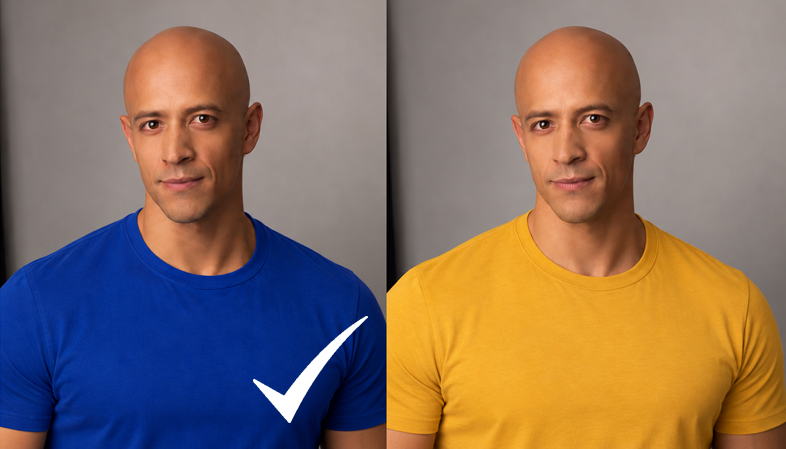
Winter royal blue vs. mustard, one of ChatGPT’s Autumn suggestions. You can see which one belongs to him. The blue brings out his eyes, while the mustard tends to make his face disappear.
There’s no substitute for an experienced color analyst who would ask about his natural hair color and, ideally, know his true season from when he was younger. A well-trained analyst should also understand the special considerations for clients who are bald or completely gray, which I cover in my ColorBreeze® training.
AI is genuinely helpful in many areas of life. But if accuracy in your color analysis truly matters to you, don’t take its answer too seriously.
The Bottom Line
A skilled human color analyst brings trained eyes that have seen thousands of faces, plus a system detailed enough to fit the real you instead of the closest box.
After three decades of doing this, I can tell you that the right colors don’t just look good. They make you look like you, only more so. And that’s still something best seen by a human who knows what to look for.
SHOP

Recent Articles


-
Why AI Cant Replace a Skilled Color Analyst
Sep 27, 26 01:04 PM
 Why AI Cant Replace a Skilled Color Analyst explains the limitations of an ai color analysis.
 -
Find a ColorBreeze® Certified Consultant | Color Allure
Aug 03, 26 03:55 PM
 Meet our certified ColorBreeze® consultants — professional color analysts trained and licensed in the full 28-season system to help you find your colors
 -
Micro Color Analysis goes a little deeper than just naming a season.
Jun 19, 26 11:09 AM
 Micro color analysis is a term I'm using for when I give a small explanation for why I chose the season I did for certain ai art images.


CONTACT
www.ColorAllure.com
Lora Alexander
lora@colorallure.com
779.770.4716

LEARN MORE
TRAINING
Learn the ColorBreeze™ System
(accepting new enrollments)
© Copyright 2008-2026 - ColorAllure. Privacy Policy