Color Analysis Myths

There are a lot of color analysis myths out there. Myths about how to find your undertones, what makeup to wear with your skin tone, etc.
Some of the tons of information you will find is accurate. But there is way too much wrong information out there. It confuses people and, quite frankly, does a disservice to the field of color analysis.
Professional color analysis is a powerful tool, but it struggles sometimes to be taken seriously. It is fighting against the belief that color analysis is not a legitimate service and is just not accurate.
This is mainly due to too many inconsistent and confusing results from color analysts themselves. My hope is that with this website and my training academy, consistency and accuracy will improve over time.
But as I stated at the beginning, there are just too many myths out there, too. I created a report of the top myths that are prevalent in our field. And need to be addressed.
If you haven't read my free report 15 Myths of Color Analysis, updated for 2026. You can now download it instantly. Just click the button on the bottom page.
Below are just a couple of highlights from the report. These are some of the most persistent myths regarding Color Analysis, and they drive me crazy.
3 Color Analysis Myths I wish would go away forever
Myth: Look at your veins to see if you are cool or warm
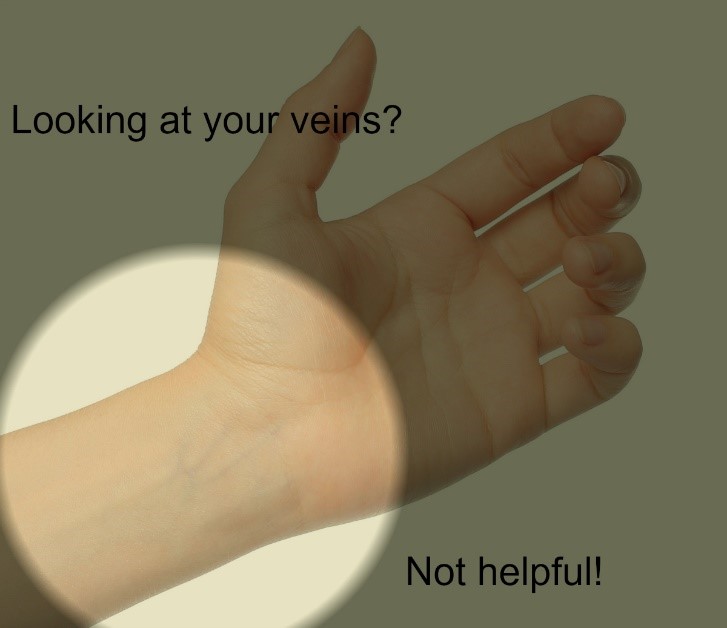
I see this all the time. But veins cannot tell you what your season is. It cannot indicate what your undertones are. It is not helpful. Period.
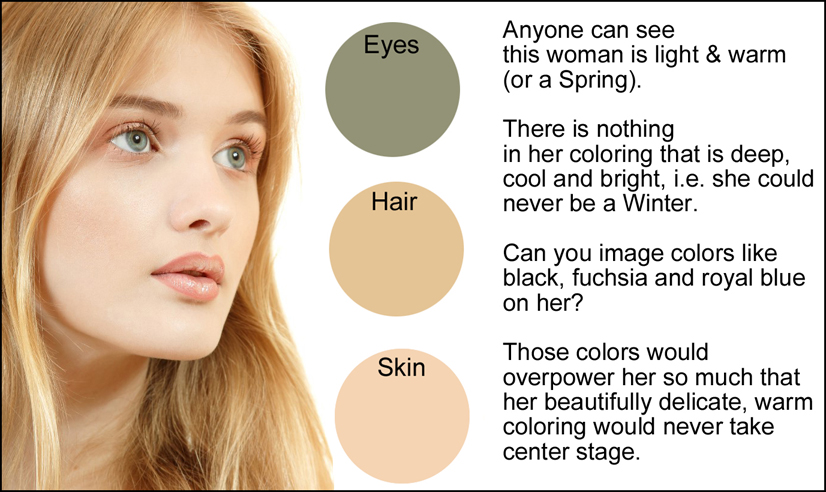
Myth: Anyone can be any season
(i.e. 'there are no rules')
In other words, according to this myth, a light, ashy blonde with cool blue eyes and cool skin could potentially be a Deep Winter, if that is how she 'drapes' out.
Or a flaming redhead with green eyes and freckles could be a Cool Summer.
This is nonsense, and it just confuses everyone.
Myth: Personality Dictates Your Season (or vice versa)
Not too long ago, I got a comment on my website regarding a virtual makeover I did. I usually ask my readers to share their thoughts on a person's coloring before I tell them what I think her season is.
Without going into too much detail, the woman, who I found out later is a color analyst herself, commented something to the effect, “I would let her personality and design preferences help determine her season". She added, “Do you know anything about her?”
Clearly, she is implying that to do a color analysis one has to learn about a client's preferences, her personality, her favorite colors, etc.
I responded to this woman with the following comment:
"I don't believe that a person's personality affects her palette or season. Color Analysis is about the 'outside' of the person - harmonizing with her skin, hair, and eyes. Once we know her category, or where she sits on Munsell's color tree, then her insides (personality and preferences) determine *how* she wears her palette."
I wanted to add how tired I am of seeing this myth out there. Color Analysis is challenging enough, and no one needs to add things into the mix that have no bearing on a correct outcome.
There is an entire ‘system’ out there built on the belief that your personality and also your body and face shape (addressed in my report, too) will determine your season. I’ve had many clients over the years who told me they had spent a small fortune on this system, not only for their analysis, but once they were analyzed, in the purchase of all new clothes and makeup. Then after trying desperately to make it work, they finally realized it was a lot of nonsense.
There is definitely merit to Style Personality, and it’s an important part of your image management tools. But that comes from inside, too, not from the outside.
You can still project an alluring style or a bohemian look, or a classic conservative look whether you are short, tall, large, or skinny. THAT does come from the inside.
But color analysis is based on the outside – skin, hair, and eyes. I call it S.H.E. in my training. S.H.E is only what is used to categorize a person’s coloring.
After she knows her best palette of colors, she can decide how best to utilize those colors based on her style personality, her profession, etc. And, of course, there is some wiggle room with colors that can be added or ignored based on her preferences.
But the palette is the starting point. And it is solely on the outside.
Looksmaxxing with Color Analysis

I just found out about the term Looksmaxing.
Looksmaxxing is "new" online subculture and social media trend focused on aggressively maximizing physical attractiveness.
I'm from the 1900's, so perhaps it's my age, but it's one of my pet peeves when young people of today come up with new names for things that have existed forever.
In our day, and ever since most of human history, we simply called it 'trying to look our best". Color Analysis helps do that, but finding one's correct color is where it all begins. And your personality is not going to be a factor in figuring that out.
I went to an esthetician school years ago, and one of my classmates was a very sweet, quiet woman who was a native of Hawaii. She was a classic Deep Winter. But she never wore the bold, dark, and bright colors of that palette. She opted for light yellows and pinks and soft earth tones. She never wore makeup. She was demure and quiet.
For our graduation, we got to dress up to the hilt (looksmaxxing, lol). My classmate wore what she said was a traditional Hawaiian outfit, which consisted of shimmery red silk and lots of black.
She was stunning!
She was still quiet and demure. She didn’t have to say a word. And yet her look stunned the rest of the class. THAT is what color analysis is about. Using colors to make you shine!
I do think some people are actually afraid to shine like that. My classmate was. And I’m not talking about dressing up in special outfits. It could just be jeans and a black T-shirt and red lipstick, and she still would have amazed us. And her personality would have been exactly the same.
It's what's on the outside that matters

So just to summarize one last time: your personality is about the inside; color analysis is about the outside.
Look at these two young professionals above, each wearing their right colors. I ask you: does anyone care what their personality is?
If the Winter on the left were demure and shy and the Spring on the right were bold and outgoing (who knows for sure and who cares), they may be tempted to switch outfits if they believe their personalities dictate their color selection.
Luckily, they don’t, and they look great.
These were just some myths. Find out more by downloading my Free "15 Color Analysis Myths" Report Now.

About the author
I'm Lora Alexander, a certified color analyst with more than 30 years of experience and over 8,000 client analyses. I developed the ColorBreeze® System, which expands color analysis to 28 seasons for a more precise fit. Many of my clients come to me after being analyzed incorrectly somewhere else. Read more about me.
Return to Home page
SHOP

Recent Articles


-
Color Analysis Myths do a disservice to our field | Color Allure
Oct 16, 26 07:15 PM
 Discover the truth about Color Analysis Myths with a Free report from Color Allure. Get your free PDF report now and debunk the misconceptions.
-
Cool Earth Tones - not all earth tones are warm | Color Allure
Oct 01, 26 11:04 PM
 Cool earth tones include stone, pebble, cool ocean blues. See my mood board of some cool earth tones of the Sunlit Soft Summer.
-
Why AI Cant Replace a Skilled Color Analyst | Color Allure
Sep 27, 26 01:04 PM
 Why AI Cant Replace a Skilled Color Analyst explains the limitations of an ai color analysis.


CONTACT
www.ColorAllure.com
Lora Alexander
lora@colorallure.com
779.770.4716

LEARN MORE
TRAINING
Learn the ColorBreeze™ System
(accepting new enrollments)
© Copyright 2008-2026 - ColorAllure. Privacy Policy