What's in a Name?
Understanding the ColorBreeze™ Season's Names
What's in a name with regard to the color analysis seasons?
For my ColorBreeze™ seasons, there is a definite logic for the names I chose.
I've mentioned before that some color analysis companies are moving away from 'seasonal' names. They say it's outdated. Instead of, say, Deep Winter, they might call it "Cool, Clear, Deep.”
Some people just come up with their own system entirely.
But I embrace the seasonal names.
And here's why: they match beautifully with the North American weather seasons. And when someone can associate something with nature, that is powerful.
Everyone can picture some variation of the photos below when any of the four seasons are mentioned.
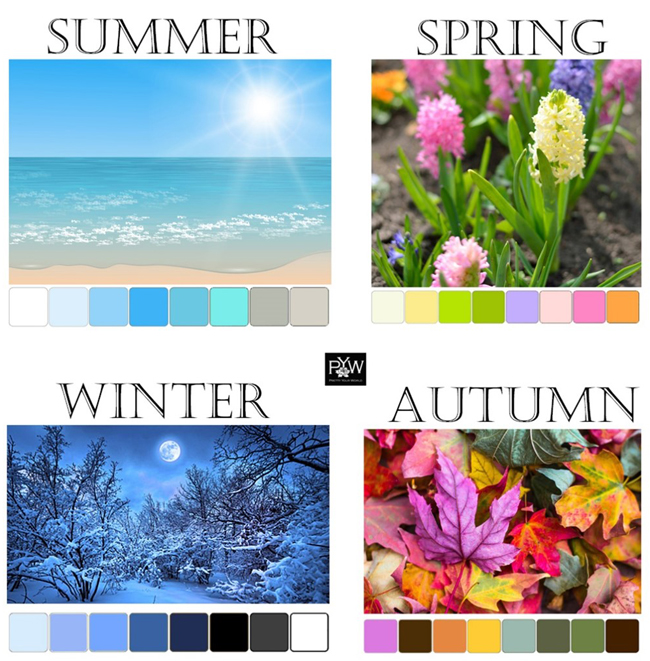
This is why I am sticking with the traditional seasonal names.
With my much more advanced ColorBreeze™ System, I did need to add a few more names to some of the newer seasons.
Names for the ColorBreeze™ seasons
Here is some advice on how to decipher the newer 3-adjective-named seasons: Read the name from right to left.
For the Sunlit Soft Summer, for example, the most important aspect of its name is that it is, first and foremost, a Summer. So, we know it's main season by looking at the name on the right
Next is the fact that its dominant trait is "Soft.” I view my ColorBreeze System, among other things, as an offshoot of the 12 seasons.
So, this is why in my training, I do say that you will need a good understanding of that system to understand the advancements that arose from it. Understanding what a truly soft season looks like first is crucial to understanding variations of it.
The Soft Summer and Soft Autumn were split into lighter and darker versions. And then, those were split into all-cool or all-warm versions, or those with blended temperatures.
The adjective 'Sunlit' means what kind of soft summer it is. Sunlit means that this soft summer (whose three main characteristics that Munsell talks about are always cool, light, and muted) is also lighter than the other soft summer (vs. the darker soft summer, which is "toasted"), and it has some visible warmth. This warmth is usually seen in the eyes and hair, but can be seen on one's skin with a slightly warm overtone.
Here is a photo that illustrates the concept (I do like visuals 😊)

"Backlit" is a term where the sun is behind the subject. In this example, it adds some sunlit highlights to her hair. I like this photo because it beautifully illustrates the "touch of warmth" often seen in these Summers.

Left, we have a true Smokey Soft Summer. I love this photo (left) because it reminds me of the exact moment I came up with the concept of "smokey".
I was analyzing someone in person. I never know for sure if it will be one particular color or colors that will be the 'aha' moment for me, or if it will be a multitude of smaller clues that lead me to my conclusion.
But there was a charcoal blue color I put below this woman's face, and that was the moment I knew her season. I envisioned her next to a campfire whose flames were replaced with just light smoke and embers.
Her blue eyes just glowed. She was definitely a Smokey Soft Summer, but I didn't have the vocabulary for that yet. I was still using the older 12-season system. But it planted the seed that would eventually develop into my ColorBreeze™ System.
Back to seasonal names...
Reading the season’s name from right to left will explain its main season, and then its sub-season.
Here are a few more things to remember about the naming of the ColorBreeze seasons:
- The lighter soft seasons will be called: Sunlit or Dusty; the deeper seasons will be Toasted or Smokey.
- There are no 'toasted springs' because spring is a light season. There are no Sunlit Winters because Winters are deep in value. Instead, you will find a Sunlit and Dusty Soft Spring, and a Toasted and Smokey Soft Winter.
- However, you will find all four adjectives in both the Summers and Autumns because those two main seasons run the gamut of both lighter and darker Soft seasons.
I hope this helps to explain the new adjectives in my system.
Return to Home page
SHOP

Recent Articles


-
Find a ColorBreeze® Certified Consultant | Color Allure
Aug 03, 26 03:55 PM
 Meet our certified ColorBreeze® consultants — professional color analysts trained and licensed in the full 28-season system to help you find your colors
 -
Micro Color Analysis goes a little deeper than just naming a season.
Jun 19, 26 11:09 AM
 Micro color analysis is a term I'm using for when I give a small explanation for why I chose the season I did for certain ai art images.
 -
Ugly Colors — Which Ones Are Actually Flattering (and on Whom
May 31, 26 12:48 PM
 Ugly colors like beige, mustard, and mauve aren't always unflattering — it depends on your season. Find out which "ugly" colors might actually work for you




CONTACT
www.ColorAllure.com
Lora Alexander
lora@colorallure.com
779.770.4716

LEARN MORE
TRAINING
Learn the ColorBreeze™ System
(accepting new enrollments)
© Copyright 2008-2026 - ColorAllure. Privacy Policy